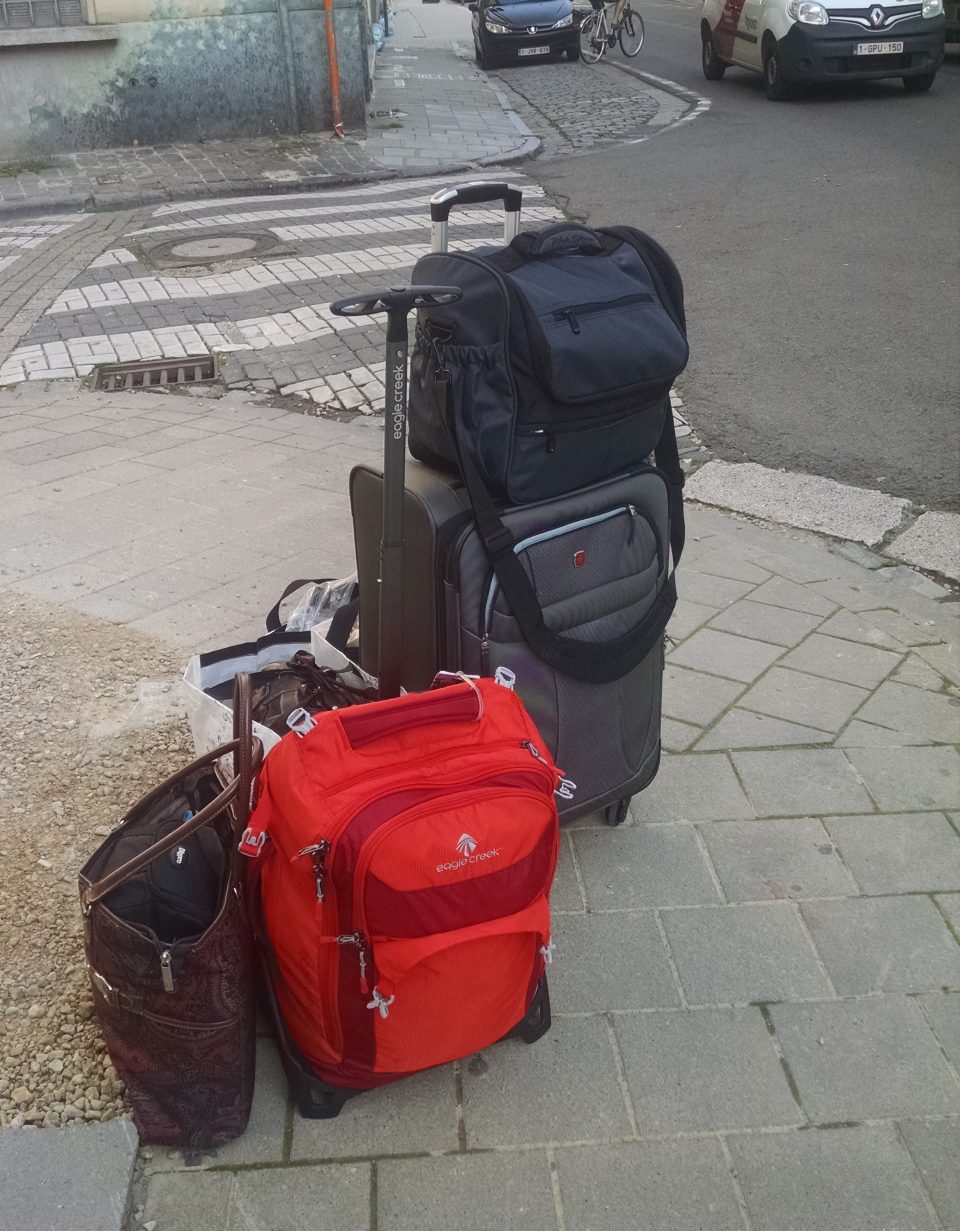
Driving into Vienna following the Danube and listening to Strauss waltzes on Spotify is like being in a dream but I was snapped back to reality when Bob asked how to get to our Airbnb. Erik, our host, had agreed to meet us early and let us into our apartment. As usual it was just as we expected. While the kitchen is compact, he has provided us with a toaster, microwave, boiler and coffee maker (although we generally have to unplug each appliance in order to plug in the one we want to use at the moment). He showed us little things like how the quirky dishwasher works, provided us with the wifi password, explained to us where we can park (including when it’s free and when we have to pay), gave us a map of the area and provided us with a key. I enjoy meeting our hosts as they give us little details about the area, and we can ask any questions we may have. It’s sort of like having a friend in every locale.
Our Airbnb is located in an area near a university with a lot of students, and lots of restaurants.
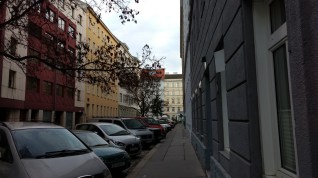
Our street and our apartment is about a half block up on the right.
We are amazed at the amount of English we hear spoken. Many young people around us speak English with accents that seem to be neither British nor American. It does make it exceedingly easy for us to communicate! After quickly settling in, we headed down to the Zur Grunen Hutte (The Green Hut), an authentic Austrian restaurant that Erik had recommended. It’s been around since 1917. Bob opted for the goulash dumplings with sauerkrat and gravy. I had the grilled chicken breast on spinach leaves with buttered rice! And of course the local beer! The dinner was yummy and we were particularly pleased to see so many locals!
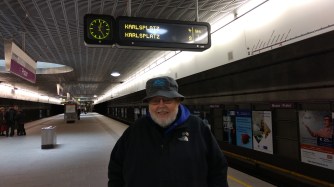
Messe Prater Station (about a block from our apartment)
While we usually take trams and busses in order to get a better feel for the city, the metro is a block from our apartment and far closer than the trams or busses and very easy to use! The trip to the center of the historical sights is only a few stops away and costs about $4.00 each for a senior round trip ticket (the machines have an English option) and we never have to wait more than a couple of minutes for a train. We’re learning that many European public transportation systems run on the honor system but if the control agent comes through and asks for your ticket and you can’t produce one, fines are hefty! We are taking no chances. We are very pleased to have an efficient, clean system so close by!
In order to get the lay of the land we decided to first take a walking tour of the historical center. We found the maps to be extraordinarily confusing and must have really looked baffled when a local came up and in perfect English asked if he could help. We finally got our bearings and set about to find Stephanplatz.


I find the mix of the new and old buildings in Vienna very interesting. We came upon Mozart’s Statue and the Vienna Opera House in new and busy parts of the city and just beyond we’d be wandering down narrow windy streets. While I understand that there is great religious significance to the Stephansdom, we have seen so many churches in Europe that they’re all beginning to look alike (We came upon three large churches and mistook all before we finally found Stephansdom.) We often pass on touring the inside (which is what we did in this case).


Perhaps the most moving site for me in all of Vienna is the Monument Against War and Facism. This monument was built on the spot where during WWII several hundred people were buried alive when their shelter was demolished.

Monument Against War & Facism
At the top of my list of Things to Do in Vienna was attend a concert. While walking along the old streets we came upon a guy selling tickets for a concert on Sunday night at the Palais Palffy just across the street from the Hofburg Palace. We looked at the program and recognized much of what they were playing, and the tickets were reasonably priced so we decided to give it a go. After we got home that evening, I checked it out on Trip Advisor and was really disappointed with the terrible reviews it received. Described the hall as shabby and the seating as crowded chairs. Wow! It seemed we had really blown this one but at least we hadn’t forked out a lot of money! We definitely lowered our expectations. How pleasantly surprised we were when the concert turned out to be fabulous!


No, it wasn’t in an elaborate hall, but the musicians were all top rate. The first half of the show was Mozart with the chamber group all decked out in period costumes and the second half was Strauss for which the group changed to appropriate attire for that time period! It was a small venue but we noticed that several tour groups came in and we figured they had paid significantly more for their tickets than we had. Many of the concerts are for the tourists and perhaps we aren’t sophisticated music buffs but we certainly enjoyed the performance and are really glad we didn’t read the reviews before we bought the tickets!
We also took the metro out to the Schonbrunn Palace and Gardens, the summer home of the Habsburgs built in the 1740’s under the reign of Maria Theresa. Empress Maria Theresa and her husband Francis I, Holy Roman Emperor, had sixteen children. Their youngest was Marie Antoinette. (We’re beginning to remember how all the European ruling families were intertwined! American students thank your lucky stars! I can’t imagine studying European history in school and trying to keep all these people straight!) Franz Joseph, Maria Theresa’s grandson and Austria’s longest reining emperor, was born at Schonbrunn Palace in 1830 and died there in 1916. (Franz Josef’s younger brother was Emperor Maximillian. And it was Arch Duke Ferninand, Franz Josef’s nephew, whose assassination precipitated World War I. I told you this is all confusing! )
Anyway, I love formal palace gardens and these were amazingly beautiful particularly because we were there in October and the majority of flowers were still blooming. Plus, the trees were beginning to turn. What a combination.


There were fountains and a maze and fake Roman ruins. (Nope, I didn’t get that either!) And we learn the most interesting things along the way in our travels. For instance, a focus of the formal gardens is the Gloriette. We learned that a gloriette is a garden building that is often elevated over its surroundings and generally has open sides. Never heard of it before. But this one was spectacular! As we walked from the metro to the palace we were reading all the posters, looking at what the venders had to offer and generally taking in the sights. There was a large portrait of a man. I nearly jumped when as I looked closely at it, he winked! I so love buscars! Then there was the anachronistic woman who stood in her period costume using her cell phone!


On the way back from Schonbrunn while we were already on the green line we decided to get off and see the Ringstrasse, a wide tree-lined boulevard that circles much of the inner city of Vienna. The idea was the brain child of Emperor Franz Josef who decided to tear down the military fortifications in the middle 1800’s and replace them with historical monuments. I had read reviews that there were cheaper ways to see it but we opted for the special Ringstrasse tourist tram because we wanted to know what we were seeing. And after walking around Schonbrunn for more than two hours a seated half hour tour sounded wonderful! On our way back to the apartment we stopped at McDonalds.


Our sandwiches actually looked like they do in advertisements and I could order a beer with it. Then we realized the people two booths down from us had their large dog with them and people nonchalantly just walked over him. We Americans could learn a lot from the Europeans!
Years ago I had taken our kids to see the Lipizzaner when they came to Ferris State University in Big Rapids, Michigan. We called them the Lipizzans but Lipizzans or Lipizzaner they are amazing horses! I wanted to see them in their Austrian home at the Spanish Riding School attached to the Hofburg Palace.

Hofburg Palace (Entrance to the Spanish Riding School under big archway)
These fantastic horses date back to the 1500’s when they were first imported from Spain. I think it’s interesting to note that during World War II they ended up in Bohemia. And the Amerians were afraid that they might fall into the hands of the Russians so in 1945 Amerian forces moved them back to Austria.


We had seats to watch the Saturday performance. The movements are known, according to Wikipedia, as “airs above the ground” and are often appropriately referred to as a ballet. It was unbelievable! The horses “danced” to classical music on a surface that looks like turf that has been groomed with a zamboni with chandeliers suspended over the field! What a sight! Just as we were leaving the building we realized that the groomers were moving many of the horses from their stables to the school for their practices which gave us an opportunity to see them up close!
We have had the opportunity to meet many wonderful people in our travels and this was especially true in Vienna. Cary had recently attended a wedding in Turkey of a good friend. There she met a wonderful couple and their daughter who live in Vienna. Cary arranged for us to meet them while we were here. Omer, the husband, texted me that they’d pick us up at a metro stop and I sent him pictures of us so they’d know who they were looking for. Shortly after we arrived at the metro stop, Omer and his family pulled up in his taxi. From the moment we met, we felt like we had always known them: Omer, his lovely wife Pakizeh and their daughter, Rana, who speaks fluent English and is an amazing accomplished young lady! When we first met, they asked if we’d prefer traditional Austrian food for lunch or would we like to try a Turkish restaurant. Here we were with new friends who had lived most of their lives in Vienna but they were Turks by birth, so we opted for Turkish food. Omer said he knew the perfect place! We all piled back in his cab and when we walked into the restaurant and were greeted in Turkish we knew we had made a great decision. We know absolutely nothing about Turkish cuisine so Omer and Pakizeh explained (often translated by Rana) various dishes particularly those that are the most popular in Turkey. Talk about yummy! The food was amazing! After we completed our meal, Omer asked if we had been to Kahlenberg . Of course, we hadn’t, so he set about taking us to this most beautiful location in the Vienna Woods. (And in my mind I began humming Strauss’, Tales from the Vienna Woods, a recital piece from half a century ago!) From Mt. Kahlenberg, high above the city, we could see all of Vienna beneath us.  It was a hazy day and Omer and Pakizeh explained on a clearer day we would see all the way to Bratislavah, Slovakia. Still it was an impressive view. On the way down from the point, we stopped to have a glass of wine in a local wine garden.


During the harvest this time of year, sturm (called Sturm in Austria, and Federweisser in Bavaria and Fiederwaissen in Luxenburg and Junger Wein in Germany) is available and the best we can surmise it is a sort of grape juice. And because Omer was driving he opted for the sturm. What a fabulous afternoon we had had with our new friends! They said they’d love to visit the United States and we would so like the opportunity to show them at least part of our country!
When they dropped us off at the metro we realized we were close to the Nachsmarkt, which was also on my list of places to visit. We spent a couple hours wandering through the stalls. Like most European markets the Nachsmarkt has many stands selling the same things. A few things that set this market apart: different sweets and nuts as well as middle eastern treats we were not familiar with, an entire line of sit down restaurants and throughout the market vendors calling out in English. We have also visited neighborhood markets near our apartment and find many interesting things: fruits that are new to us, lots of local beers, and even a marijuana grow shop!


Two weeks in Vienna. Like all our other stays, the time passes at lightening speed and it’s time to move on. We say goodbye to Vienna, we’ll spend a day in Bratislova and then head to Krakow, Poland! What an unbelievable two weeks it’s been!
 It had an amazing choice of options: croissants and coffee, a huge variety of fruits and vegetables, sweets and ice cream, amazing choices of main dishes. And as we sat enjoying our selections we were once again surprised to see a dog curled up at his owner’s feet. It would be so much easier to travel with a dog in Europe than in the US!
 Because of the Alps the motorway is a mass of tunnels. (I think we counted 41 on just this single day of driving.) We left Switzerland and crossed into tiny Leichtenstein. While there was a small building that at one time must have been the border crossing it was vacant this morning.
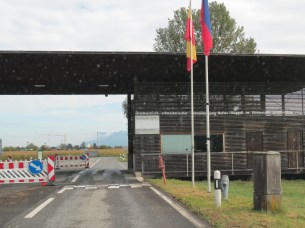 I think it took us no more than fifteen minutes to cross the country. I read where in 2011 Snoop Dogg tried to rent the country. It’s unclear whether it ever went through but at one time it was advertised that it was possible to rent out the entire country for $70,000 a night complete with customized street signs. Novel idea!


 We later read that Frielassing was an imporant Allied target near the end of World War II. Although it had no real strategic importance it was the area where Hitler, Goering, Bormann and others had vacation homes and where they would gather to do strategic planning.

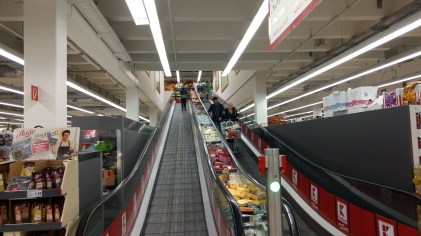 They have a huge selection of just about anything we could want from fresh vegetables and fruits to frozen food, to entrees we could heat in the oven. My daughter had introduced me to Google Translate which is a handy free app that allows you to translate on the fly. This had been a great help in our previous travels. But I recently learned that you can also take a picture with Google Translate and it translates signs or any other text instantaneously! I found this particularly useful at the grocery store when I could take a picture of a package and immediately know what the product was. It was really helpful in deciphering subleties…like diced tomatoes from tomato paste, etc. I also really like the app when dealing with home appliances. For instance, when I want to do the laundry. You may recall that two years ago we got our wash locked in a washing machine in Prien, Germany, because we couldn’t understand the signs on the machine. With the app all I had to do was aim my phone at the machine and it translated: short wash (big difference between 1 hr 55 min and 40 minutes!), prewash, machine lock, etc. Really helpful!
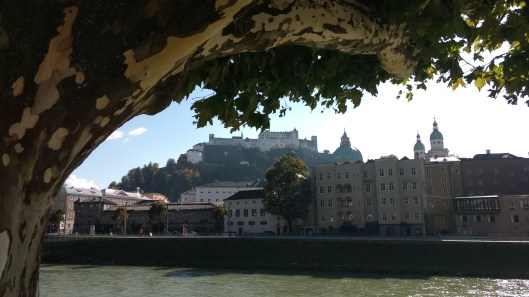 It is a small area that was easy to traverse by foot. The castle was used as a prison in the 20th century first holding Italian soldiers during World War I and then Nazi activists before the Anschluss with Germany (or annexation of Austria by Germany). Salzburg is Mozart’s home; that’s what I most wanted to see. So we walked to his birthplace and then also to his residence. We decided we’d wait and attend a concert when we get to Vienna! (We did notice a street sign near Mozart’s birthplace that read, “Urban Decay.” We had to wonder about the history of that sign!)


 They told us a lot about Salzburg and the area’s salt history and suggested we go to Bad Reichenhall just a short distance from where we were. The salt works from this area date from the 1840’s. For hundreds of years the “white gold was mined here.” I was surprised to learn that salt comes in different colors and that it’s often white because the other colors are bleached out of it.
  The colors come from natural elements incorporated into the salt crystals.


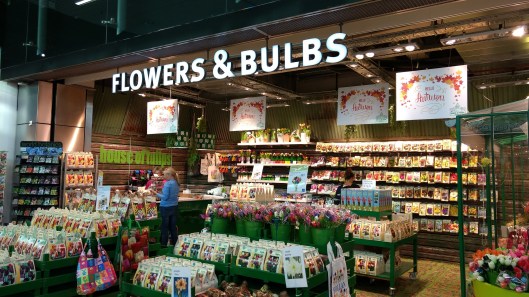


 We only had a day in Turin and we had been told about the Egyptian Museum that is supposed to be the best outside of Egypt and the only one outside of Cairo that is totally dedicated to Egyptian art and culture. Bob says he’d never seen so many mummies in his life. We found it interesting how the burial rituals slowly changed over time. For instance, at first all the individual’s possessions were placed with him to take to the afterlife. Then over time that was changed to representations of the food. We also learned that a cubit is the distance between the tip of one’s middle finger and the elbow! Interesting tidbit!


 Brunnen is also the home of the Swiss Army Knife. They have a museum dedicated to it which in reality is just another gift shop.


 She also gave us a map of Lucerne so we could plan out our trip in advance. Europeans are so much more accomodating regarding dogs! The ticket office had a sign reminding passengers that their dog would need a ticket as well.


 Bob and Jane's Excellent Adventure